Skip to content
Connact NetworksConnact Digital SolutionsRequest a private consultation
Bespoke community platforms and private digital networks

Build the network your institution should own.

Connact builds a private, branded network for one institution at a time: a summit that runs all year, a government programme, a professional association, an innovation ecosystem. Members carry a verified identity and real credentials. Every claim inside can be checked in seconds, by anyone you allow.

Your productNamed as yoursYour dataExport any timeYour rulesGovernance you setYour perimeterYour cloud, your keys
Record · work:structural-review-4471
connact.me/verify/8c41d0

Lead structural review, Al Bidayer Pavilion

Held by Dr. Amina Rahal · Structural Engineering

Provenance
Attested by a named witness
Witness
Omar Haddad, Principal, Meridian Consult
“I commissioned this work.”
Notarised
2026-03-14 09:41 GST · root a7f3…9e2b
Disclosure
Link only, set by the holder
Open the proof →Externally witnessed

Illustrative record · fictional data

Who this is for

Four kinds of institution build one of these, each for a different reason.

This is the short version, so you can tell in a minute whether you are in the right place. Full detail on every model is one click away.

Events and summits

Year-round event and summit networks

Keep the people, knowledge and momentum from your event alive all year, not just during it.

Government and experts

Government and expert collaboration

Give experts and officials one trusted place to work together across programmes and administrations.

Associations and membership

Professional and membership communities

Give members a professional identity and peer network worth renewing for.

Innovation and challenges

Innovation and challenge ecosystems

Carry ideas, people and evidence from one cohort into the next instead of starting over.

A common first question: is this a self-service platform we set up ourselves? No. Connact designs, builds and brands a distinct platform for your institution. There is no signup and no template gallery.

The institutional problem

Your most valuable relationships should not disappear between moments.

Audiences, expertise and institutional memory sit scattered across four systems. None of them was designed to hold the whole relationship, and one of them you don’t even own.

System 01

Public website

Knows what you published. Knows nothing about who read it, or who they are.

System 02

CRM records

Knows who is eligible. Holds no relationship a member would recognise as theirs.

System 03

Events and programmes

Knows who attended, once. Goes dormant the week after, taking the context with it.

System 04

External channels

Holds the conversation, the graph and the attention. All of it lives on infrastructure you will never control.

Visibility without identity.You are seen by people you cannot name.

Records without relationships.You hold rows, not standing.

Activity without memory.Every cycle starts from zero.

Why identity and proof matter now

AI can generate almost anything except proof of who really did it.

Content, credentials and even video are now easy to produce and hard to trust. What stays difficult to fake is a dated record, witnessed by a named person, that existed before anyone needed it to exist.

What is now easy

What is still valuable

Content, portfolios, reports, media

ProvenanceWho actually made this.

Claims, résumés, self-description

AccountabilitySomeone with something to lose said it.

Forgeable identity, synthetic media

A real historyA record that existed before it was convenient to have one.

Work that looks credible but might not be real

AttributionWho did the work, and who is willing to say so publicly.

Every community platform on the market sells the column on the left: publish, engage, connect. Connact builds the column on the right, and it is the only part of this category that becomes more valuable as the models improve, not less.

Anatomy of one claim

It starts as a statement.

Someone says they did something. On every other platform this is where it ends: a line on a profile, no different from a line invented this morning.

Nothing enters a Connact network without who says so attached. Self-declared is a valid form of provenance too. It is simply labelled as one, honestly, and it reads differently because of that.

A named person stands behind it.

A witness attests, and states their relationship to the work in their own words. Both sides consent. The witness’s identity and standing travel with the claim, permanently.

This is why we never show a follower count or a number of endorsements. A named witness who states their relationship is worth more than any counter could be.

It is sealed into history.

The record is signed and appended the moment it exists. Its root hash is mirrored to an append-only public witness that neither we nor your administrators can rewrite. The past can only be reversed by a later, equally visible event.

A record like this gets harder to fake over time, not easier, because nobody can go back today and create one dated 2024.

A stranger checks it in seconds.

Every claim gets a permanent address that resolves on its own, the same way for a person in a browser and for a machine fetching structured JSON. Revocation and expiry are shown honestly rather than hidden.

This is the number we ask institutions to judge us on: three phone calls and a week of email, replaced by one request.

Stage 01 / 04: Declared
Record · work:structural-review-4471
connact.me/verify/8c41d0

Lead structural review, Al Bidayer Pavilion

Held by Dr. Amina Rahal · Structural Engineering

Provenance
Attested by a named witness
Witness
Omar Haddad, Principal, Meridian Consult
“I commissioned this work.”
Notarised
2026-03-14 09:41 GST · root a7f3…9e2b
Witnessed by
External mirror · verified independently
Disclosure
Link only, set by the holder
Open the proof →Externally witnessed

Illustrative record · fictional data

Try to break it

You cannot change the past without everyone seeing.

Each record’s hash is derived from the one before it, and the final root is mirrored to an append-only witness outside your infrastructure. Alter a record and watch every link after it stop reconciling.

Root matches the external witnesswitness cf42d96ccomputed cf42d96cAlter any record below

Each record’s hash is derived from the one before it, and the final root is mirrored to an append-only witness outside your infrastructure. Try altering a record: you cannot change the past without the mismatch becoming visible to everyone.

The product, not a description of it

What your members and your operators actually see.

Four surfaces from the same foundation. The brand, the terminology and the journeys are designed for one institution, and the machinery underneath is shared.

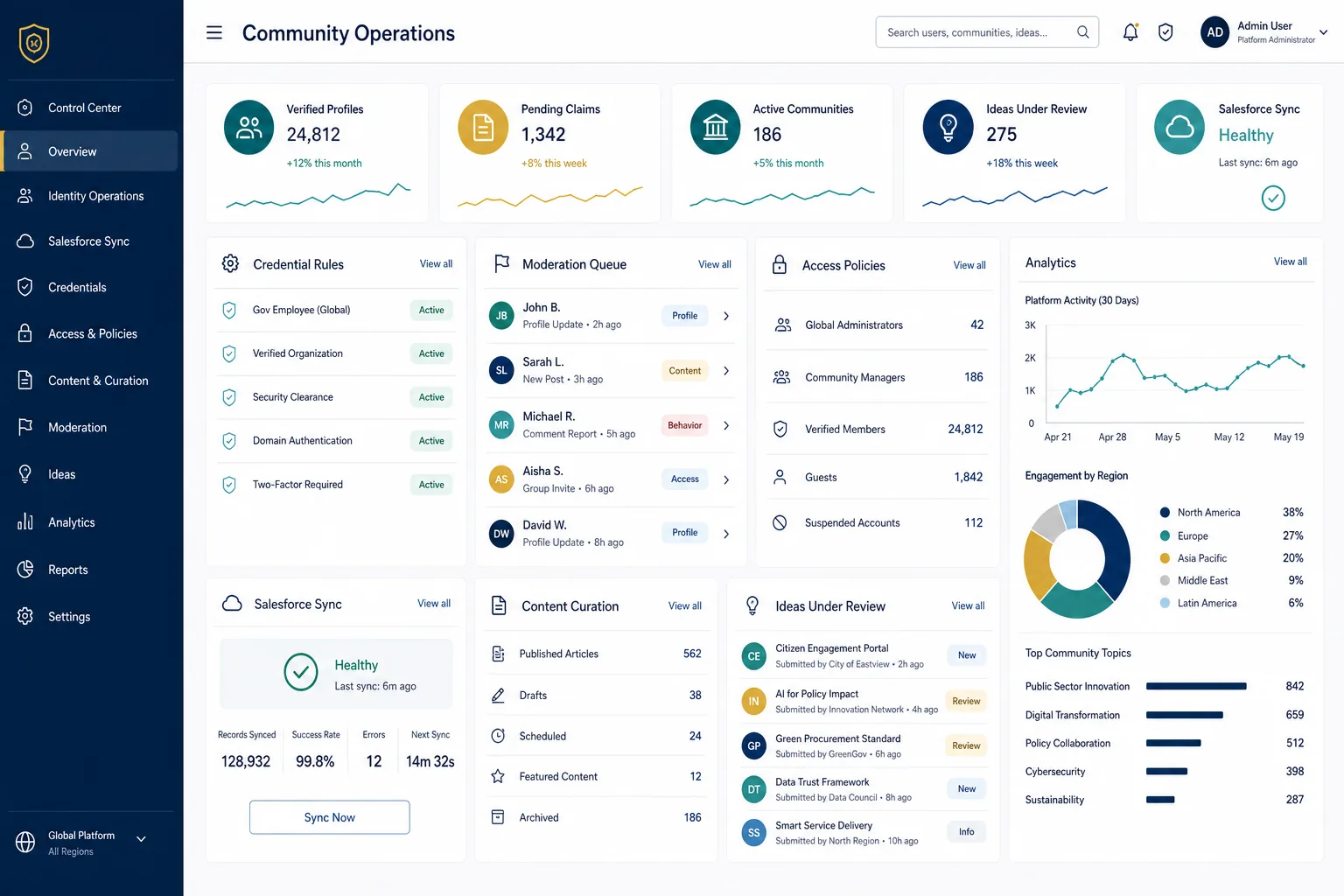
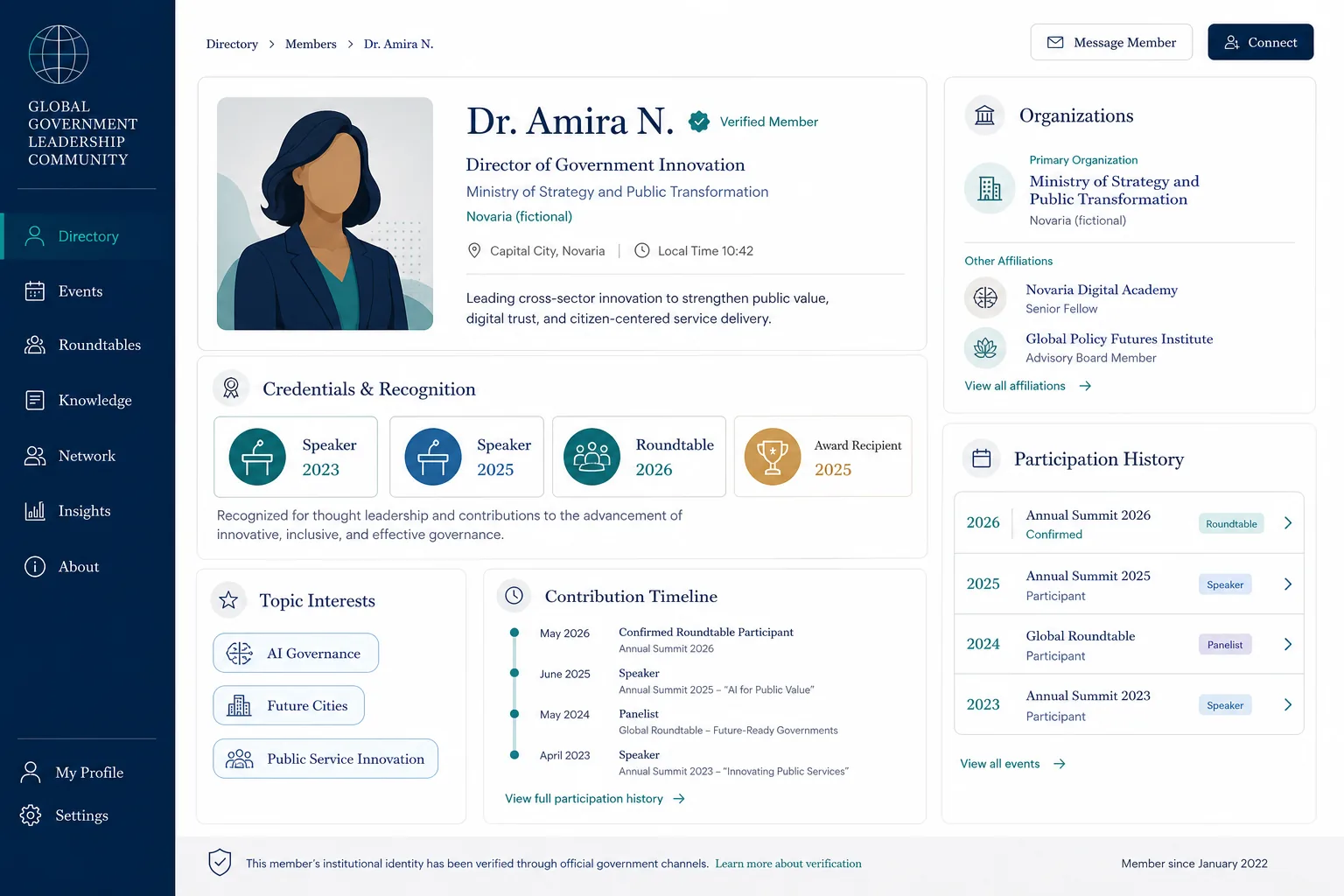
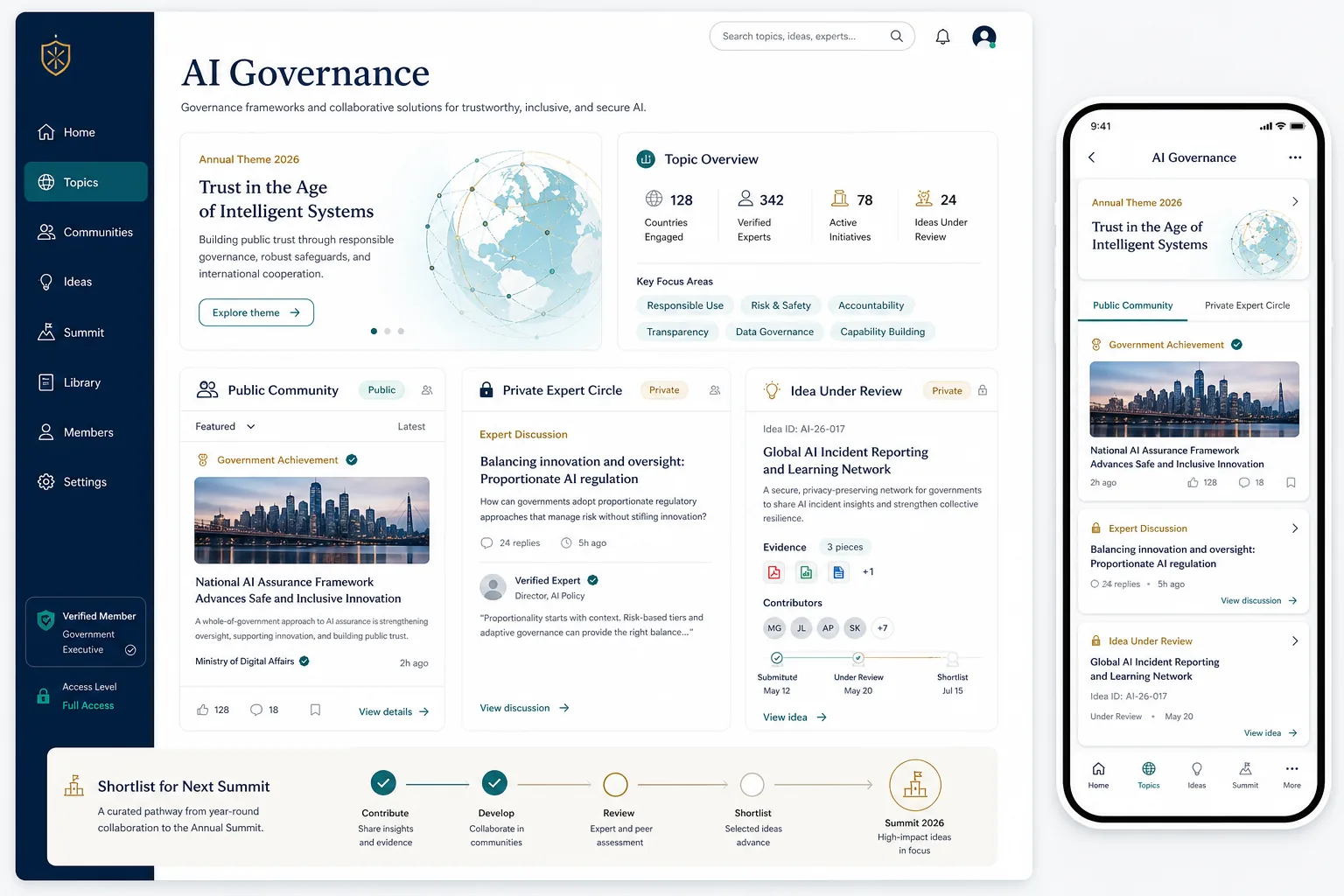
A member profile showing verified identity, credentials by year, organisation affiliations, topic interests and a dated contribution timeline.A topic hub for AI Governance showing an open public community, a locked private expert circle, an idea under review with evidence, and the same view on mobile.An operations dashboard showing verified profiles, pending claims, credential rules, a moderation queue, access policies, CRM sync health and analytics.
01 / 03Member record · credentials, affiliations and participation history
The operator’s view

The half of the product that wins the evaluation.

Members see a network. The people who run it see a console: rosters, claim queues, credential issuance, access levels, moderation and publishing controls. Almost every competitor treats this as an afterthought, and it is where your team will actually live.

Registry
Roster import with a dry run before anything is written, and a claim queue where operators approve who becomes whom.
Issuance
Credentials offered rather than imposed. The recipient accepts them, and expiry and revocation are treated as first-class from the start.
Access
Space-level membership, tiers and visibility, with the boundary between public discovery and private participation made explicit.
Audit
An activity log that answers who changed what and when. It is kept separate from the signed record, and never confused with it.
An operations dashboard showing verified profiles, pending claims, credential rules, a moderation queue, access policies, CRM sync health and analytics.
Operations console · illustrative, fictional data
Built for the agent era

Your members will bring agents. Your partners will send them.

Three things institutions will need inside eighteen months and cannot buy off the shelf today. Each is possible here because consent and disclosure are first-class concepts in the model, not an access-control list bolted on afterwards.

Delegated grants

A member can tell an agent it may act for them, on named records, until a stated date. Access is revocable at any time and comes with a receipt they can read. The alternative is members pasting their credentials into tools nobody has vetted.

Extends the existing grant model

Governed retrieval

Every institution wants an assistant over its own knowledge. Most fail the same way: the assistant answers from documents the person asking was never cleared to see. Disclosure is checked here at the moment of the query, per item, per person.

The wall most institutions hit first

Cited answers

Output that resolves to provenance-bearing records with verify links attached, instead of a fluent summary nobody can check. An answer a board member can act on, and defend afterwards.

Machine-readable by design
Delegated grant

Grant access to an agent

Awaiting your decision
Agent
Meridian Research Assistant
Acting for
Dr. Amina Rahal
Expires
5 December 2026 · 90 days
It may read these records, and nothing else
Revoke at any time · no notice requiredreceipt 20dedccc
{
  "subject": "profile:person/a.rahal",
  "requestedBy": "agent:meridian-research",
  "grant": "20dedccc",
  "expires": "2026-12-05T23:59:59Z",
  "disclosed": [
    { "id": "licence:pe-4471", "type": "credential", "provenance": "attested" },
    { "id": "work:structural-review-4471", "type": "work", "provenance": "attested" }
  ],
  "withheld": 1,
  "signature": "ed25519:a7f3…9e2b"
}
Signed response · verifiable without calling Connact

Try it: revoke a record and watch the signed response change. The agent is told what it may not see, including a count of what was withheld, rather than being handed everything and trusted to look away. Illustrative, fictional data.

When a partner’s agent arrives to check whether someone really holds a credential, it should get a signed answer in a second, not a form and a three-day wait.

One connected ecosystem

Give every system a single responsibility.

Connact does not replace what already works. It occupies the gap none of your current systems was built to hold: the persistent, governed relationship.

System of record: public

The website

Public authority, discovery, publishing and search. It informs the world, and hands identified visitors onward.

System of relationship

The network

Trusted identity, governed participation, credentials, contribution and institutional memory that survives every cycle.

System of record: internal

The CRM

Eligibility and authoritative institutional records. It stays authoritative, and receives only the signals you approve.

The website informs the world. The network activates the community. The CRM verifies the relationship.

Owned, governed and connected

Your product. Your brand. Your data. Your rules.

Ownership is a product decision, not a footer claim. It shapes identity, access, publishing, hosting and the operating model from the first discovery session onward.

Direction

Product direction

The outcomes, audiences, experience priorities and roadmap belong to the institution.

Identity

Brand

Every client platform is separately named and expressed. It is never presented as a Connact-branded tenant.

Custody

Data

Authoritative sources, exchange boundaries, hosting and responsibilities are agreed before delivery begins.

Control

Governance

Eligibility, access, moderation, publishing and recognition rules are controlled by your organisation.

We do not hold your data hostage.

Full export, any time, at no cost. An agent can now move a member’s records in seconds, so data lock-in stopped being a real moat some time ago and we do not pretend otherwise. What holds a member to this network is the witnessed history it holds for them, and that has to be earned.

Before you get in touch

The questions we are always asked.

Answered here rather than held back for a call, because a decision this size should not require one to begin.

Is this a self-service community platform we configure ourselves?

No. Connact Networks is a productised enterprise service. We bring a reusable foundation, then design, integrate, brand and deploy a distinct product for your institution. There is no signup, no tenant and no template gallery.

Who owns the brand, the data and the governance rules?

You do. The institution owns its product direction, brand, data and governance. Deployment model, data flows and operational responsibilities are agreed during discovery and written down before delivery begins.

Why does the engagement have to begin with paid discovery?

Because the right network model depends on member journeys, governance, existing systems, hosting constraints and how success will be measured. Discovery makes those decisions explicit before anyone commits to delivery. You keep the prototype, scope, roadmap and investment range whether or not we build it.

What does it actually cost?

Discovery is a fixed fee. Design and delivery are quoted as a programme once discovery has defined the scope. Ongoing cost is an annual institution-wide licence plus an evolution retainer, never per seat, so the network does not get more expensive because it succeeded. We share indicative ranges in the first conversation.

Can it run inside our own cloud, or in our country?

Yes. Connact-managed cloud, your own cloud or private environment, and in-country residency are all supported deployment models. The complete system, application, database, search, storage and media, deploys as containers into your environment, under your own keys and network perimeter.

How does it integrate with our CRM, CMS and identity provider?

Through OpenAPI-documented REST APIs, OAuth 2.0 and OpenID Connect, event webhooks and a TypeScript SDK. Your CRM or membership system stays authoritative for eligibility and records; the network receives or verifies only the signals you approve.

What happens to our existing public website?

It stays. The website informs the world, the network activates the community, and the CRM verifies the relationship. We do not duplicate your public site. We convert its visitors into identified, governed participation.

Do you support Arabic and right-to-left?

Yes. Layout, typography and bilingual information architecture are designed in from discovery, not added afterward. Right-to-left affects the whole product, which is why it has to be a decision made early.
Private consultation

Designed for organisations that treat community as strategic infrastructure.

Tell us about the network, the institution behind it and the systems it must live alongside. We will tell you honestly whether there is a product here worth building, and what discovery would need to answer first.

Organisation · Contact role · Network type · Approximate member scale · Current systems · Launch horizon · Hosting and sovereignty requirements